
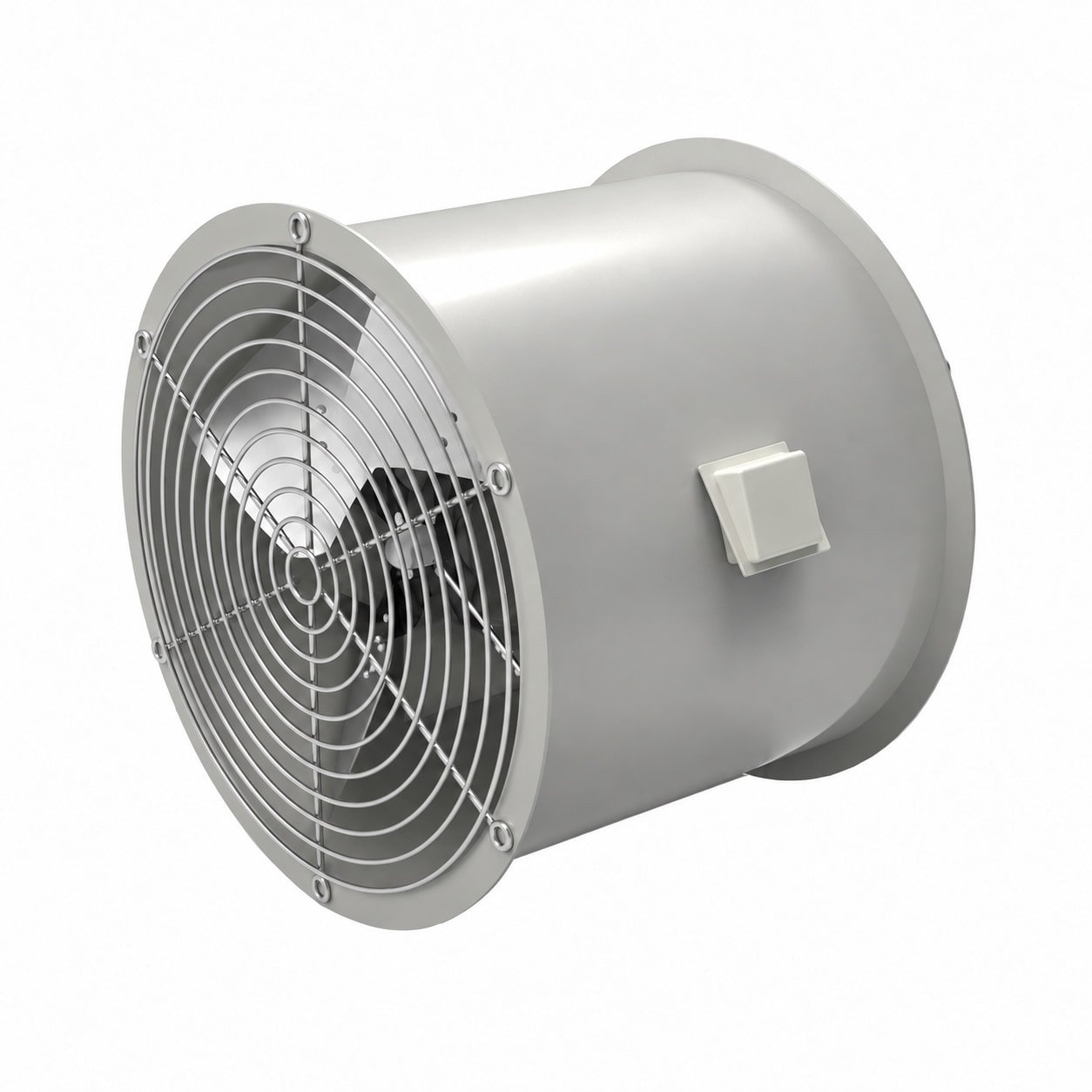
Choosing an industrial fan by airflow alone is a common and expensive mistake. A workable selection needs the design airflow, system resistance, gas temperature and composition, installation arrangement and operating schedule. Those inputs define the operating point on the fan curve.
Start with the required airflow
Airflow is usually stated in m³/h, m³/s or CFM. Air changes per hour can give a rough figure for general building ventilation, but it is not enough when the space contains a strong heat source, dust, fumes or hazardous substances. In those cases, the calculation should reflect the heat load or contaminant generation rate.
State whether the figure is a normal, peak or emergency duty. If the system has more than one operating mode, list each one.
Airflow needs a pressure value
Ducts, bends, dampers, filters, silencers and process equipment all create pressure loss. A fan rated for the right free-air volume may deliver much less once connected to the real system.
Specify whether the project requires static pressure or total pressure, and where that value applies. Mixing the two is an easy way to move the selected fan away from its intended operating point.
Check the whole operating range
The duty point is where the fan curve meets the system curve. Check efficiency, absorbed power, sound data and the recommended operating range around that point. If a variable-frequency drive will be used, include the minimum and maximum duties rather than checking only full speed.
Temperature and gas composition matter
Temperature, altitude and gas composition change density. Dust may require a different impeller, heavier wear protection or access for cleaning. Corrosive gas affects casing, impeller, shaft and coating selection. A hazardous atmosphere needs the area classification and electrical requirements, not just the words “explosion proof.”
Information to send with an enquiry
- Design airflow and units
- Static or total pressure, with the calculation boundary
- Normal, maximum and emergency duties
- Gas temperature, composition, dust and corrosiveness
- Altitude and ambient temperature
- Voltage, frequency, phase and control method
- Installation position, inlet and outlet arrangement
- Noise, material, coating and document requirements
Related equipment: T35 Axial Fan and 4-72 Centrifugal Fan.
Technical note: available materials, coatings, certifications and temperature ratings must be confirmed against the selected model and project documents.
Need help matching the fan?
Share airflow, pressure, medium, temperature and installation conditions for the next technical step.
Send an enquiry